
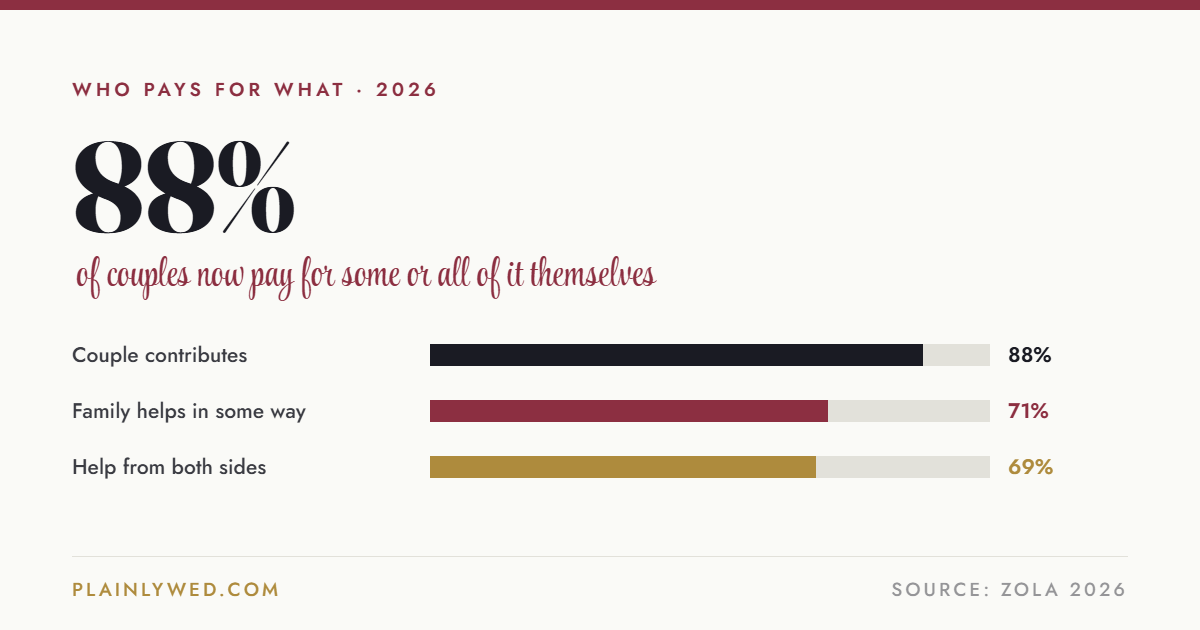
In 2026, 88 percent of couples pay for some or all of their own wedding. 29 percent pay for the whole thing.
Family help is still normal. 71 percent of weddings get some. When families do chip in, both sides give about 69 percent of the time.
So the old rule is gone. The bride’s family paying for everything is now the exception, not the norm.
But the list of who pays for what is the easy part. The hard part is the conversation, and almost nobody tells you how to have it.
Every guide gives you the same three things. A traditional breakdown from a century ago. Some stats showing nobody follows it anymore. And the advice to “have the money conversation early.”
Then they stop. Right at the point where it gets difficult.
This article covers the list, briefly. You need the reference. Then it covers what to say, and in what order. And what to do when the money comes with strings attached.
What the numbers actually look like now
Zola’s 2026 First Look Report found that 88 percent of couples contribute financially to their own wedding. Twenty-nine percent fund the whole thing themselves. Fifty-nine percent pay for part of it.
Family help is still normal, not rare. 71 percent of weddings receive some. When families do chip in, both sides give about 69 percent of the time.
The old model is now the minority. Most couples fund their own wedding, in part or in full. Family money arrives on top of that, not instead of it.
What family money actually changes
Two findings here should shape your conversation. Neither one shows up in an etiquette list.
Couples who pay 70 percent or more themselves spend 23 percent less overall. That is a Zola finding.
At the top end, above $100,000, families cover 63 percent of the bill.
The gap is mostly not fancier flowers. It is people. When a parent contributes, they usually contribute a guest list too.
Guests run $300 to $400 all-in. So forty extra names is $12,000 to $16,000. That is before anyone upgrades a single vendor.
That is not an argument against accepting help. It is the reason the guest-list question below has to be settled before the money moves, not after.
The traditional breakdown, for reference
The Emily Post Institute still publishes the classic division. Even they will tell you every line can change. It is useful mainly because your parents may still have that model in their heads.
| Traditionally paid by | Covered |
|---|---|
| Bride’s family | Ceremony and reception venue, catering, flowers, music, photography, invitations, the dress, the planner |
| Groom’s family | Rehearsal dinner, officiant fee, marriage license, and in many regions the bar tab |
| The groom | Engagement ring, bride’s wedding band, honeymoon |
| The bride | Groom’s wedding band, gifts for the wedding party |
| Wedding party | Their own attire and travel |
| Guests | Nothing at the wedding itself, ever |
That last line matters more than it looks. If you run into a cash bar as a guest, that is on the hosts, not on you.
The bar tab is worth flagging for another reason. It is the item most likely to cause sticker shock. A full open bar for 150 guests can cost more than the food.
How to actually have the conversation
This is the part every other guide skips. Here is the sequence that works.
Step one: decide your number first, alone
First, you and your partner need two figures. What you can give yourselves. And what the wedding you want really costs.
Walk in without those numbers and whatever they say becomes the plan.
Our wedding budget calculator gives you a real total for your guest count. It includes the service charges and tax that quotes leave out.
Ten minutes with it, before the first family talk, beats any etiquette list.
Step two: ask, do not hint
The most common mistake is fishing. Describing the venue you love and waiting to see if someone offers. It puts everyone in an uncomfortable position and it usually produces a vague answer you cannot plan around.
Ask both families the same question, separately, in roughly the same week. Ask one first and the other later, and you create a comparison. Neither of them asked to be part of that.
Step three: get a number, not a category
“We’ll take care of the flowers” sounds generous. It is also almost impossible to plan around. Neither of you knows yet whether flowers means $1,500 or $6,000.
It also means someone has to go back and ask for more if the florist quotes high.
A fixed sum protects the giver as much as it protects you.
Step four: name the strings before they appear
Money often comes with expectations, and the expectations are usually unspoken. The guest list is where they surface: a family who contributes frequently assumes they can invite people.
This is much easier to raise while everyone feels generous. Much harder three months later over a seating chart.
Maybe the contribution does come with real conditions. Then you know that before you have spent any of it. That is a good outcome, even if it feels uncomfortable.
Step five: write it down and share it
Not a contract. Just one shared document. It lists who is giving what, and when it moves. Most family friction over wedding money comes from two people remembering a conversation differently.
When it does not go smoothly
One family can contribute and the other cannot
This is common and it is not a problem unless you make it one. Do not tell either family what the other gave. There is no version of that information that helps.
The family who cannot give money often wants to give something. Let them.
Hosting the rehearsal dinner at home. Making the cake. Handling transport. Doing the ceremony flowers. That counts as taking part, and it should.
Someone promises and then reduces it
It happens, usually because they overestimated in a warm moment. Respond once, without pressure, and then replan around the real figure rather than around the promise.
The contribution comes with a demand you cannot accept
Then the answer is no. Say it early. Do not take the money and fight about it for a year. A wedding you can afford beats one you can afford with conditions.
Questions couples actually ask
Who pays for the wedding in 2026?
Most of it is now paid by the couple. Zola surveyed over 11,500 couples. 88 percent contribute money, 29 percent fund the wedding entirely, and 59 percent pay part.
Family help stays common. 71 percent of weddings get some.
The old model, where the bride’s family pays for most of it, is now the exception.
Is it rude to ask parents to pay for the wedding?
No, as long as you ask rather than assume. Make it genuinely easy to say no. The question does not cause offense. The expectation does.
Ask both families separately, in the same week, with the same wording. Do it after you know what you can give yourselves.
Does the groom’s family still pay for the rehearsal dinner?
Often, and it remains the most persistent piece of the traditional model. But it is increasingly funded by the couple or shared.
Treat it as a reasonable thing to ask about rather than something owed.
Should we tell each family what the other contributed?
No. Nothing good comes from it. It invites comparison. It can shame the family who gave less. It can make the family who gave more feel their gift was a lever.
Keep a shared record of the total budget if you like. Keep the sources between you and your partner.
What if we do not want anyone’s money?
That is an entirely normal choice, and roughly three in ten couples make it. It is the simplest way to keep every decision yours.
Say it kindly and early. Families who expected to help can feel shut out.
“We’ve decided to cover this ourselves. It matters to us to do it that way. We’d still love your help with the parts that aren’t money.”
The short version
The traditional list is a historical artifact and your parents may still be carrying it. The modern averages describe other people’s families, not yours.
What decides how this goes is simple. Walk in knowing your own number. Ask directly instead of hinting.
Turn offers into fixed amounts. Settle the question of influence before you spend a penny of it.
As etiquette expert Lizzie Post put it, it is not a question of who should do what. It is who can, and would like to, participate.
Read next
- How much does a 100 person wedding cost in 2026?The full model: fixed costs, per-guest costs, and the roughly 21% that lands on top of every quote.
- Wedding budget calculatorSplit the budget by who is paying for what, then see the real total each side is committing to.