
Your wedding day timeline doesn’t start with your ceremony time. It starts with your sunset.
Those two move on their own. A 4pm ceremony in June leaves you three hours of good light afterwards.
The same 4pm ceremony in November leaves you none at all. Golden hour ends before you’ve said your vows.
Every timeline guide tells you sunset is the most important input on your wedding day.
Then each one hands you a sample schedule built around somebody else’s sunset. And tells you to go look yours up on Google.
This article does the part they skip.
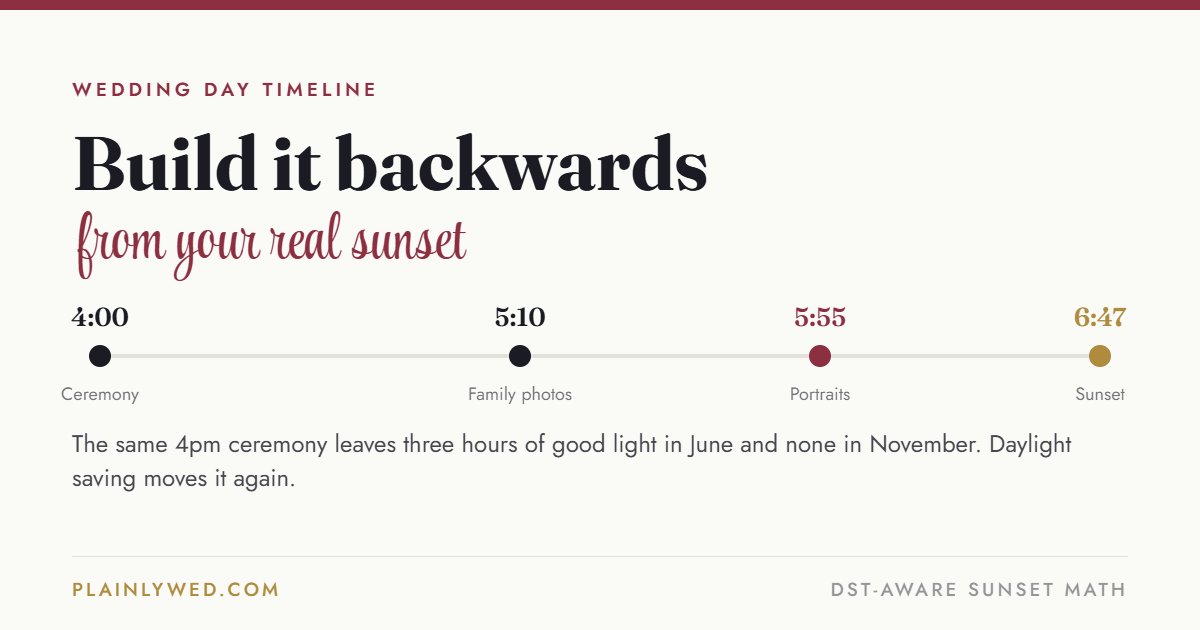
The same ceremony time, nine different days
Here’s a 4pm ceremony running thirty minutes, in Chicago, across the wedding season.
Golden hour is the last hour before sunset. The portrait window you can use is the middle of it.
| Wedding date | Sunset | Portrait window after your ceremony |
|---|---|---|
| 18 April | 7:34pm | 2 hours later |
| 16 May | 8:04pm | 2.5 hours later |
| 20 June | 8:29pm | 3 hours later |
| 18 July | 8:23pm | 2.9 hours later |
| 15 August | 7:52pm | 2.4 hours later |
| 19 September | 6:54pm | 1.4 hours later |
| 17 October | 6:07pm | Tight. 37 minutes later |
| 14 November | 4:32pm | None. Light gone by 4:17pm |
| 12 December | 4:20pm | None. Light gone by 4:05pm |
Nothing about the wedding changed except the date. Same ceremony time, same guest count, same photographer.
In June you can wander off after dinner for portraits. In November the best light happened while your guests were still finding their seats.
This is the single most common timeline mistake. It almost always happens in winter. The couple picked their ceremony time in a warmer month.
Our wedding timeline maker works out the real sunset for your date and location. Then it builds the whole day backwards from your ceremony.
It scales hair and makeup to the number of people in the chair. Dinner scales to your guest count.
And it warns you if your ceremony sits after the light has gone. Free, no sign-up.
Build it backwards, not forwards
Most couples build a timeline forwards from the alarm clock, adding blocks until they reach the ceremony. That’s the wrong direction. It’s why mornings run late.
A wedding day has two fixed points: the ceremony and the sunset. Everything before the ceremony is math. Everything after it runs at the pace of feeding your guests.
What the blocks actually take
| Block | Realistic time |
|---|---|
| Hair and makeup | 60 to 75 minutes per person |
| Getting-ready photographs | 60 to 90 minutes |
| Into the dress, final details | 30 minutes |
| First look and couple portraits | 45 to 60 minutes |
| Wedding party photographs | 45 to 60 minutes |
| Family groupings | About 2 minutes each |
| Ceremony, non-religious | 15 to 30 minutes |
| Ceremony, religious | Up to 1 hour |
| Cocktail hour | 60 minutes |
| Dinner | 75 minutes minimum |
| Speeches | 5 minutes per speaker, hard limit |
| Golden hour portraits | 15 to 30 minutes |
Family grouping time is about 2 minutes per combination, per photographer Micah Chaffin, quoted by The Knot. Count your groupings before you budget the block. Ten is a normal list. Twenty-five will take nearly an hour.
The one that surprises everyone is hair and makeup. A party of five with two stylists takes roughly three and a half hours.
A party of eight with one stylist can start before six in the morning.
The fix is more chairs, not faster work.
A 4pm ceremony in September, worked through
Sunset at 6:54pm, five people in hair and makeup, ten family groupings, 110 guests, first look.
Note where golden hour sits: partway through dinner. That’s deliberate, and it’s the easiest slot to use.
Your guests are seated and busy. They won’t notice you’ve gone for a quarter of an hour.
In spring and fall it usually falls during cocktail hour instead. In winter, if it falls at all, it’s right after the ceremony.
Where timelines break
- No buffers. Leave five to fifteen minutes between every block. Without slack a timeline runs late, never early. The lost time comes out of your portraits. They’re the only block with no fixed end.
- Underestimating hair and makeup. Count the people, multiply by 70 minutes, divide by the number of stylists. Do that before you book anything.
- Family photographs with no list. Two minutes a grouping only holds if someone is rounding people up. Give one person from each family that job by name.
- Travel time not doubled. Door to door, plus parking, plus the person who isn’t in the car yet.
- No first look on a winter date. Without one, every portrait has to happen after the ceremony, which in December is after dark.
Common questions
What time should our ceremony start?
Work backwards from sunset, not forwards from breakfast. Without a first look, aim for a ceremony three to four hours before sunset. That leaves room for portraits in good light.
In June that’s a mid-afternoon start. In late October the same wedding needs to begin around one o’clock.
Pick a ceremony time without checking your date’s sunset. It’s the most expensive small mistake in wedding planning.
How long does wedding hair and makeup take?
Roughly 60 to 75 minutes per person, with the bride usually last so her makeup is freshest. Five people with one stylist is close to six hours.
Two stylists roughly halve it. That’s the only reliable way to shorten this block.
Do we need a first look?
It’s a scheduling decision as much as an emotional one. A first look moves roughly half your portraits to the morning.
That means you attend your own cocktail hour. Instead of getting photographed through it.
For a winter wedding it’s close to essential. After the ceremony there’s no light left.
When should golden hour portraits happen?
You only need fifteen to thirty minutes, in the last hour before sunset.
Where it lands depends on the season. During dinner in summer. During cocktail hour in spring and fall. Straight after the ceremony in winter.
Put it on the timeline rather than hoping for it. It’s the block that gets lost when anything else runs over.
How much buffer should we build in?
Five to fifteen minutes between every block, and more around travel or large group photographs.
Buffers aren’t padding. Hair runs over, a bouquet goes missing, an aunt is in the wrong room. A timeline with no slack fails at the first delay.
The short version
Look up your sunset before you choose your ceremony time, not after. Build backwards from the ceremony.
Multiply hair and makeup by the number of people in the chair. Put golden hour on the schedule as a real block.
Get those four right and the rest of the day mostly runs itself.
Read next
- Wedding day timeline makerEnter your date and venue and it works the whole day backwards from your actual sunset.
- Wedding seating plannerThe other half of day-of logistics: who sits where, and who cannot sit next to whom.
- What time should your wedding ceremony start?Sunset by month for 30 US cities, the exact subtraction, and the hour daylight saving quietly costs you.