
A 100-guest wedding in the US costs about $30,000 to $36,000 in 2026. But that’s just what vendors quote you.
Your final invoices usually run 15 to 20 percent higher. Service charges, tax on those service charges, tips and vendor meals all come later.
So plan on $34,500 to $43,000 for 100 guests. That’s about $345 to $430 per guest.
Search this for an evening and you’ll collect five different answers.
One site says $9,000. Another says $45,000. A caterer says $7,000. Reddit says a hundred people at a hundred dollars a head, so thirty grand.
They’re not all wrong. They’re answering different questions, and none of them tells you that.
Why every guide gives you a different number
The published numbers disagree because they measure different things. Once you know which is which, the range collapses.
| What the figure actually covers | Typical range |
|---|---|
| Catering only, food per head before fees | $70–$150 pp |
| Reception only: venue, food and bar | $12,000–$18,000 |
| Whole wedding, vendor quotes added up | $30,000–$36,000 |
| Whole wedding, what you actually pay | $34,500–$43,000 |
| The number to plan against | $345–$430 per guest |
The gap between the third row and the fourth is what this article is about. Almost nobody publishes it.
What a 100-guest wedding costs, category by category
These are quoted prices, before the fees in the next section. National figures, mid-range choices, no destination travel.
| Category | Share | 100 guests |
|---|---|---|
| Catering and bar | 33% | $10,890 |
| Venue and rentals | 28% | $9,240 |
| Photography and video | 12% | $3,960 |
| Flowers and decor | 8% | $2,640 |
| Attire, hair and makeup | 7% | $2,310 |
| Music | 6% | $1,980 |
| Rings, license, transport, everything else | 3% | $990 |
| Cake and desserts | 1.5% | $495 |
| Stationery and signage | 1.5% | $495 |
| Quoted total | 100% | $33,000 |
Benchmarked against The Knot’s 2026 Real Weddings Study, which surveyed 10,474 couples married in 2025: catering $80 a head, bar $2,800, florist $2,800, cake $540, invitations $510, DJ $1,800. Those are averages among couples who bought each service, so they do not add up to any one wedding. These are shares of a lean $33,000 wedding, not averages. Venue and food together come to 61 percent, which is why guest count moves your total more than any other decision.
The part the quote does not include
This is where budgets break. Your caterer quotes a per-head price. That price isn’t what shows up on your invoice.
The service charge
Venues and caterers add a service charge of 18 to 22 percent. Usually 20. It isn’t a tip, and it usually doesn’t go to the staff.
It covers the venue’s cost of service. They apply it to your food and beverage subtotal.
Tax on top of the service charge
In most states, sales tax comes after the service charge. So you pay tax on the fee, not just the food.
Take a 20 percent service charge and 8 percent tax. A $16,000 food and beverage subtotal becomes $20,736. That stacking is what surprises people.
Gratuity, separately
The service charge often skips the staff. So many couples tip on top of it.
Budget 3 to 5 percent of your total for tips. That covers the officiant, hair and makeup team, and delivery drivers. Also the bar and catering staff, and the band or DJ.
The small line items nobody quotes
- Cake cutting fee: $1.50 to $4 per slice if you bring in an outside cake
- Vendor meals: most contracts make you feed the photographer, videographer, planner and band. Usually $25 to $50 each
- Alterations: budget at least $300, no matter what the dress cost
- Overtime: venues charge by the hour, and price it to put you off
- Corkage, delivery, setup, breakdown and rental damage waivers
What that does to the total
| Line | Amount |
|---|---|
| Quoted total, all vendors | $33,000 |
| Food and drink, from the table above | $10,890 |
| Service charge on food and drink (20%) | +$2,178 |
| Tax, applied after the service charge (8%) | +$1,045 |
| Gratuities (4% of the quoted total) | +$1,320 |
| Vendor meals, cake cutting, alterations | +$900 |
| What you actually pay | $38,443 |
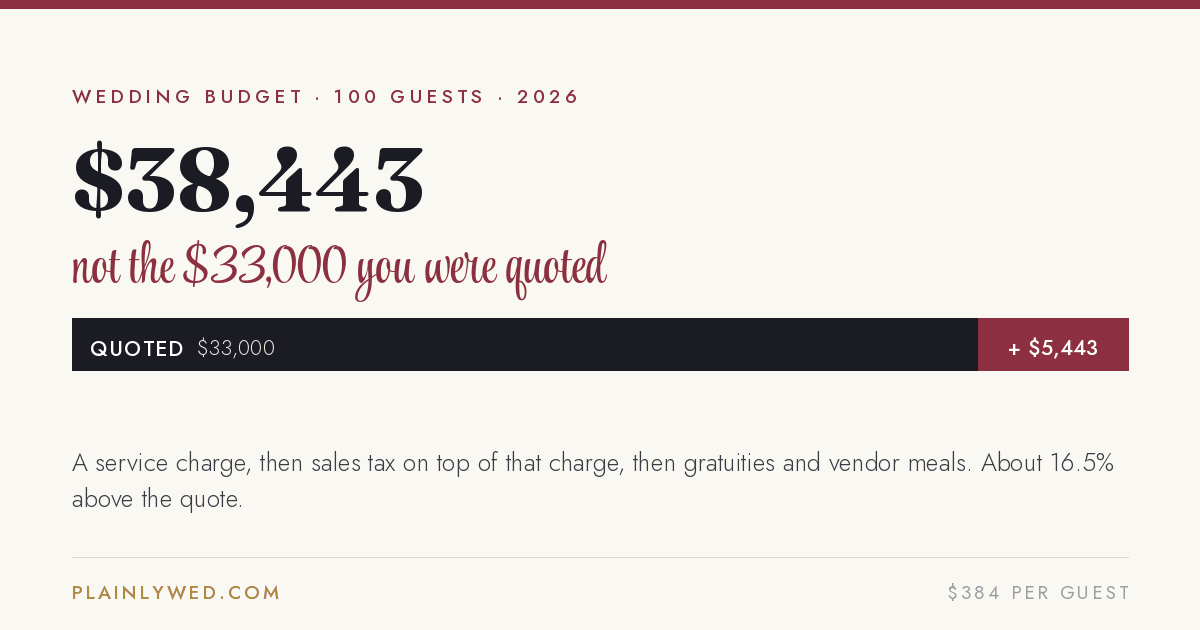
That’s 16.5 percent above the quoted figure. And nobody added anything fancy. No upgrades, no overtime, no changed minds.
Your uplift is not a flat number. The service charge only lands on food and drink. So the more of your budget goes there, the bigger the gap.
One rule covers it. Every $1,000 of food and drink adds about $296 to your final bill. That is $200 of service charge, plus $96 of tax on the new subtotal.
At a third of your budget on catering, expect about 16 percent. At half, expect closer to 22.
Zola’s research found that 69 percent of couples exceed their wedding budget. Consumer Reports found roughly two in three blow past their reception budget by 20 percent or more.
The Knot found the average overspend was $7,347. Those numbers match the fee stack above almost exactly.
Most couples aren’t overspending. They’re paying fees nobody showed them.
What each additional guest really costs
Couples usually price a guest at the per-head catering rate, around $85. The real cost of one more guest runs much higher. A guest brings more than a dinner.
- Food and beverage at quoted price
- The service charge and tax on that food
- A share of a larger cake, more rentals, another chair and place setting
- Another invitation, another favor, another seat on the transport
All in, each extra guest costs $150 to $260. At 100 guests, cutting twenty people saves $3,000 to $5,200.
That usually beats trimming any other single category. And neither you nor your guests would notice on the day.
Our wedding budget calculator does this math for your total and guest count. It splits your budget across categories.
Then it adds the service charge, the tax stacking on it, tips, vendor meals and cake cutting. You see the quoted figure next to what you’ll really pay. Free, no sign-up.
How much your region changes things
Location moves the total more than any choice except guest count. The Mid-Atlantic and New England are the priciest regions in the country.
New England averages around $46,600. Much of the South and Midwest sits well below the national figure. Oklahoma averages roughly $23,000.
As a rough adjustment, start from the $33,000 quoted baseline. Major metros in the Northeast and California run 40 to 50 percent higher. Smaller markets and off-season dates run 20 to 30 percent lower.
A Saturday in June and a Friday in November aren’t the same price at the same venue.
Where the money is actually saved
In order of how much they move the total:
- Guest count. Twenty fewer people is worth more than every other saving combined.
- The date. Off-season, or any day that isn’t Saturday, changes venue pricing a lot.
- Bar format. Beer and wine rather than a full open bar, on consumption rather than per head.
- In-season flowers. Blooms in season cost 30 to 50 percent less than the same variety flown in.
- An all-inclusive venue. One that provides tables, chairs and linens removes $1,500 to $3,000 from your rentals column.
What doesn’t save real money? Cutting the photographer. DIYing things that need a pro. Trimming a category that was only 3 percent of the budget anyway.
Questions couples actually ask
Is $25,000 enough for a 100-person wedding?
Yes, in most of the country. But it takes decisions, not trimming. At $25,000 all-in you’re looking at roughly $250 a guest.
That usually means an off-season or non-Saturday date. A venue that includes rentals. Beer and wine instead of a full bar, and in-season flowers.
In a major coastal metro, $25,000 for 100 guests means changing the guest count instead.
Is $10,000 a realistic wedding budget?
For 100 guests, not for a traditional seated dinner reception. $10,000 across 100 people is $100 a head all-in. Catering alone usually starts at $70 before fees.
$10,000 works well for 30 to 50 guests. It also works for anything that isn’t a plated dinner. A brunch, a cocktail reception, or a ceremony with a party later.
What is the average cost per guest at a wedding?
$250 to $400 per guest all-in, depending on region and style. Catering alone is $70 to $150 per person before service charge and tax.
Changing your guest list? Use the extra-guest number, not the average. Each added guest costs $150 to $260 once you count food, fees, rentals and stationery.
Does the service charge go to the staff?
Usually not, and this catches people out. A service charge is revenue for the venue. It covers their cost of service.
A gratuity (a tip) is money for the staff. They’re different lines, and a venue can legally charge both.
Ask this directly before you sign. Does any part of the service charge go to the service staff? Is extra gratuity expected?
Get the answer in writing. It changes your budget by thousands.
How much should I hold back as a buffer?
Between 5 and 10 percent of your total. Don’t touch it until the final month.
Emergencies aren’t the point. This covers what you can’t know at booking. The final headcount. The overtime hour you decide is worth it. The transport nobody planned.
If your budget only balances by spending the buffer, it doesn’t balance.
The short version
Plan on $34,500 to $43,000 for 100 guests. Treat any quoted figure as roughly 17 percent below what you’ll pay.
Then ask every venue and caterer the same two questions before you sign. What is the service charge? Does tax come before it or after?
Those two answers are worth more than any budget template.
Read next
- Wedding budget calculatorPut your own quote in and see what it becomes once the service charge, the tax on it, gratuity and vendor meals are added.
- Who pays for what at a weddingThe traditional split, what modern couples actually do, and what each line is worth in dollars.