
Your anniversary is coming up. You looked up what you are supposed to give. You got five different answers.
You did not misread them. The lists really do disagree. The reason is more interesting than anyone lets on.
The short version: the traditional list goes paper, cotton, leather, fruit and flowers, then wood. That is the older of the two.
The “modern” list goes clock, china, crystal, appliances, then silverware. Jewelers pushed that one, and it is almost a hundred years old itself.
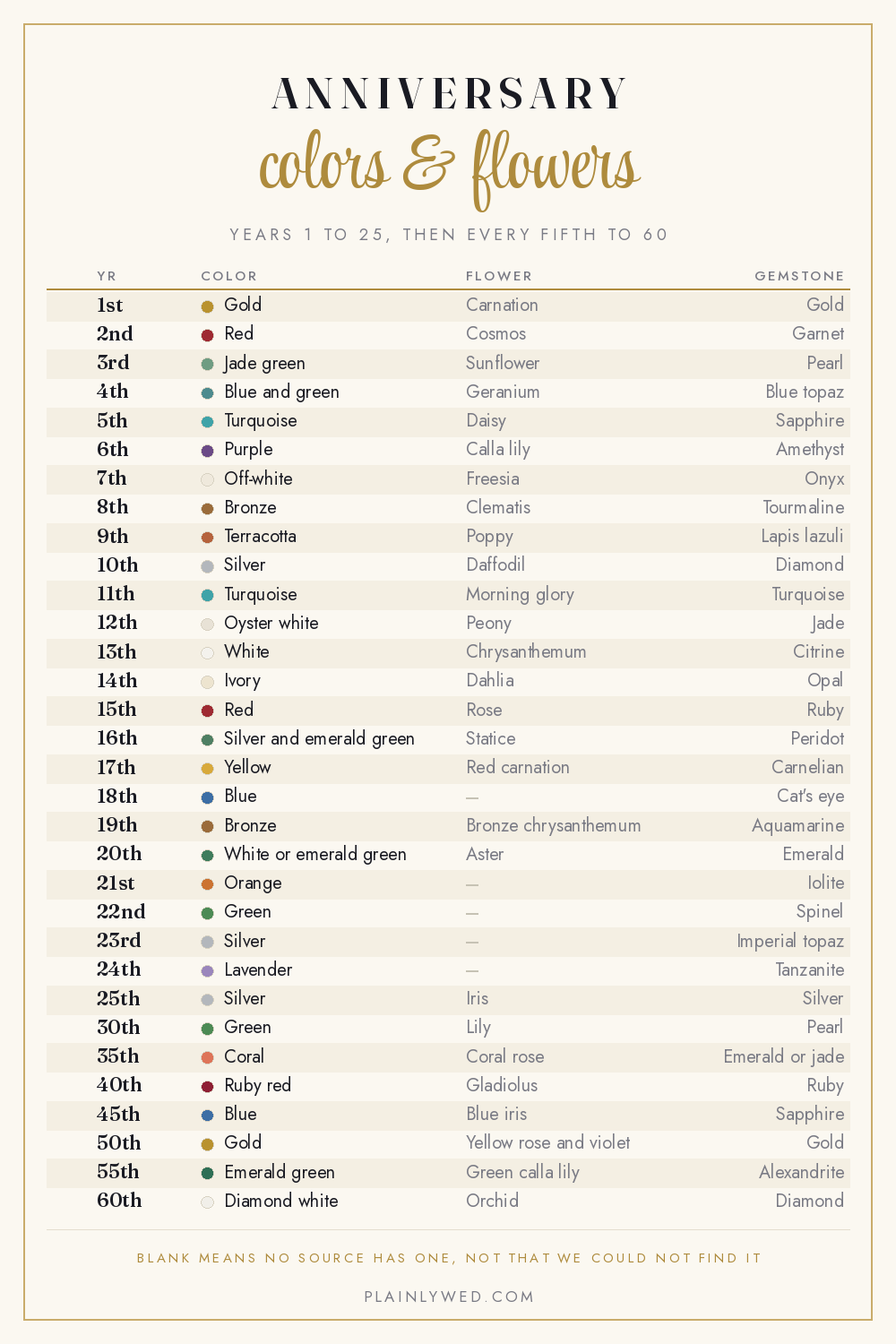
Below is every year from 1 to 25, plus every milestone up to 75. You get all five symbols: traditional, modern, gemstone, flower and color.
Then comes the part nobody prints. Some of these are real traditions. Some were made up to sell you things.
Anniversary gifts by year: 1 to 25
These years rest on the firmest ground. Every source agrees on the shape of this range. Single entries wobble, but the pattern holds.
The gemstone column is the best backed of the five. It is not unanimous. Jewelers of America and the International Gem Society split at years 7, 9 and 12.
One says onyx, lapis lazuli and jade. The other says yellow sapphire, morganite and alexandrite. We print the Jewelers of America values.
| Year | Traditional | Modern | Gemstone | Flower | Color |
|---|---|---|---|---|---|
| 1st | Paper | Clock | Gold | Carnation | Gold |
| 2nd | Cotton | Chinaware | Garnet | Cosmos | Red |
| 3rd | Leather | Crystal or glass | Pearl | Sunflower | Jade green |
| 4th | Fruit and flowers | Appliances | Blue topaz | Geranium | Blue and green |
| 5th | Wood | Silverware | Sapphire | Daisy | Turquoise |
| 6th | Iron or candy | Wood | Amethyst | Calla lily | Purple |
| 7th | Wool and copper | Desk set | Onyx | Freesia | Off-white |
| 8th | Bronze and pottery | Linen and lace | Tourmaline | Clematis | Bronze |
| 9th | Pottery and willow | Leather | Lapis lazuli | Poppy | Terracotta |
| 10th | Tin and aluminum | Diamond | Diamond | Daffodil | Silver |
| 11th | Steel | Fashion jewelry | Turquoise | Morning glory | Turquoise |
| 12th | Silk and linen | Pearls | Jade | Peony | Oyster white |
| 13th | Lace | Textiles and furs | Citrine | Chrysanthemum | White |
| 14th | Ivory | Gold jewelry | Opal | Dahlia | Ivory |
| 15th | Crystal | Watches | Ruby | Rose | Red |
| 16th | Wax | Silver holloware | Peridot | Statice | Silver and emerald green |
| 17th | Furniture | Furniture | Carnelian | Red carnation | Yellow |
| 18th | Porcelain | Porcelain | Cat’s eye | none listed | Blue |
| 19th | Bronze | Bronze | Aquamarine | Bronze chrysanthemum | Bronze |
| 20th | Chinaware | Platinum | Emerald | Aster | White or emerald green |
| 21st | Brass or nickel | Nickel | Iolite | none listed | Orange |
| 22nd | Copper | Copper | Spinel | none listed | Green |
| 23rd | Silver plate | Silver plate | Imperial topaz | none listed | Silver |
| 24th | Opal | Musical instruments | Tanzanite | none listed | Lavender |
| 25th | Silver | Silver | Silver | Iris | Silver |
A note on the blank cells. Years 18 and 21 through 24 have no flower on any main list. That is not us failing to find one. There simply isn’t one.
The colors for years 21 to 24 do show up on several sites. Every site gives the same four colors. Not one says where they came from.
That is what a copied list looks like. Most pages fill these cells anyway. We would rather show you the hole.
Anniversary gifts by year: 30 to 75
Past year 25, the milestones get solid again. The years in between fall apart. Here are the milestones, which are the real ones.
One warning about the far end. Both gemstone sources we use stop at year 60. The stones for 65, 70 and 75 only appear on shop pages.
Smoky quartz at 70 has no source we could trace at all.
| Year | Traditional | Modern | Gemstone | Flower | Color |
|---|---|---|---|---|---|
| 30th | Pearl | Diamond | Pearl | Lily | Green |
| 35th | Coral | Jade | Emerald or jade | Coral rose | Coral |
| 40th | Ruby | Ruby | Ruby | Gladiolus | Ruby red |
| 45th | Sapphire | Sapphire | Sapphire | Blue iris | Blue |
| 50th | Gold | Gold | Gold | Yellow rose and violet | Gold |
| 55th | Emerald | Emerald | Alexandrite | Green calla lily | Emerald green |
| 60th | Diamond | Diamond | Diamond | Orchid | Diamond white |
| 65th | Blue sapphire | Blue sapphire | Blue sapphire | none listed | Sky blue |
| 70th | Platinum | Platinum | Smoky quartz (disputed) | none listed | Platinum |
| 75th | Diamond and gold | Diamond | Diamond | none listed | Diamond white |
The in-between years, 26 to 49
This is where it gets strange. Almost every chart just stops.
The Knot has the most-read chart. It runs years 1 to 20, then only the multiples of five.
MasterClass, the International Gem Society and Wikipedia stop at 25 and pick up again at 30. So if your 27th anniversary is next month, that chart has nothing for you.
Fill that gap and you find two rival lists. Dozens of sites copy them. One is an old materials list. The other is Hallmark’s themed list.
They agree on almost nothing.
| Year | The materials list | Hallmark’s themed list |
|---|---|---|
| 26th | Pictures or original art | Art |
| 27th | Sculpture | Music |
| 28th | Orchids | Linens |
| 29th | Furniture | Tools |
| 31st | Timepiece | Travel |
| 32nd | Conveyance | Bronze |
| 33rd | Amethyst | Iron |
| 34th | Opal | Food |
| 36th | Bone china | Antiques |
| 37th | Alabaster | Books |
| 38th | Beryl | Luck |
| 39th | Lace | Laughter |
| 41st | Land | Office decor |
| 42nd | Real estate | Clocks and watches |
| 43rd | Travel | Entertainment |
| 44th | Groceries | Electronics |
| 46th | Original poetry | Games |
| 47th | Books | Garden and plants |
| 48th | Optical goods | Home improvement |
| 49th | Luxury items | Copper |
One list says the 44th anniversary is groceries. The other says the 39th is laughter and the 38th is luck.
Neither one was passed down by anybody. They are two attempts to fill twenty empty rows.
So here is the honest answer for years 26 to 49. There is no set gift.
No flower and no color exists for these years on any main list. A few gemstones do get handed out.
The Knot’s single-year pages give amethyst for the 33rd and turquoise for the 44th. That same page says the 44th has no official flower.
But those stones sit on one-off pages, not on any list, and nothing backs them up.
Those pages also copy the materials list exactly. Sculpture at 27. Groceries at 44. That tells you it is a leftover that got copied.
Shopping for one of these years? Pick from either column. Or ignore both.
Nobody at the party knows what the 34th anniversary gift is, because there isn’t one. You have more freedom here than on any other year.
That is the opposite of how gift guides make it feel.
Why no two lists agree
These are not sloppy mistakes. They are the fossil record of a tradition that got rewritten twice. Once by etiquette. Once by business.
The traditional list is genuinely old, but shorter than you think
The German “golden wedding” for fifty years shows up around 1600. Silver at twenty-five is harder to pin down.
The proof firms up in the 1700s, with silver wreaths at twenty-five years and gold at fifty.
For a long time that was the whole tradition. Two anniversaries. Both about lasting a long time together. Neither one asked you to buy anything.
Some English reference books date both metals to the 1500s. We use the later dates, because those have a source behind them.
Emily Post published Etiquette in 1922. Most people assume that book set the rest of the rules.
Go read it. The full text is free and out of copyright. There is no year-by-year list in it at all.
The wedding anniversary part names six things, in this order: paper, wooden, tin, crystal, silver, golden. No numbers. No china. No diamond.
Post was blunt about the cheap end. She wrote that “the paper, wooden and tin wedding presents are seldom anything but jokes.” Crystal, she said, is the first one people take seriously.
Sit with that. The etiquette expert everyone quotes thought the cheap end was a running joke. And she never numbered any of it.
The “modern” list was built to sell jewelry
Here is the story you will find everywhere. The American National Retail Jewelers Association published the modern list in 1937.
The group is real. The date is not.
That 1937 date comes from one gift book published in 2001. The book cites nothing.
Jewelers of America does not claim the list in its own history. Neither does the standard reference entry on the group.
What the trade press did record is a starting point, not a publishing date.
TIME reported the real story from that trade press. The group met in 1922. That is the same year Emily Post published Etiquette.
One man at the meeting was quoted in the Jewelers’ Circular. He pointed out that the wooden and tin years came long before the gold and diamond ones.
In his words, “the jeweler surely derived very little profit until after he had waited 50 or 75 years for a golden or diamond anniversary.”
Over the next decade or so, the group got to work. TIME reports they built one list that jewelers everywhere could use.
That is where the modern column comes from. It is not a folk custom that drifted.
It is a trade group that looked at a list with nothing to sell until year fifty. Then they fixed that.
Which is why the modern list puts diamonds at ten instead of tin. And gold jewelry at fourteen instead of ivory.
And jewelry of some kind at years 10, 11, 12, 14 and 15 in a row.
It is called modern, and it is about a century old
Whatever year it settled, the modern list took shape in the 1920s and 30s. That is why it reads so oddly now.
Today the list still says the fourth year is appliances. The seventh is a desk set. The thirteenth is furs.
We have no dated original to prove those were the first entries. But nobody would pick them today.
They read like the wish list of a comfortable house before the war. And you are handed them as the up-to-date option.
Even the authorities contradict themselves
- Emily Post’s own institute misquotes Emily Post. Its site says the 1922 book “included eight specific occasions.” Then it lists seven. It adds china at the 20th, plus year numbers that are nowhere in the book.
- Jewelers of America lists “watches” as the 17th-year gemstone. That is not a stone. It is a product.
- The International Gem Society says there is no official gemstone list for wedding anniversaries. Then it prints one.
- The 45th anniversary color is given by several sites as “sapphire red.” Sapphires are not red.
One thing is not a contradiction, to be fair. Hallmark drops ivory from the 14th year and runs gold jewelry there instead.
It says so right on the page. It does not support the ivory trade. That is a fair call, not a slip.
It does leave the traditional and modern columns the same for that year.
The lists reuse the same materials, sometimes under different names
The 2nd modern gift is china. So is the 20th traditional gift. Both mean chinaware, the dishes, not the country.
The 18th is porcelain in both columns. China and porcelain are the same material under two names.
The 36th on the materials list is bone china. That one is a real variant, not another name. It has bone ash in the clay.
Three slots, one material family, three labels. No source explains the difference.
The repeats go well beyond china. Bronze turns up at 8 and 19. Pottery at 8 and 9.
Furniture at 17 and 29. Lace at 13 and 39. Opal at 14, 24 and 34. Diamond at 10, 30, 60 and 75.
A list built once, from scratch, would not repeat itself like that. These were filled in by different people at different times.
The sixth anniversary has three different answers
Iron, candy, or sugar. It depends which country’s list you land on, and which decade someone copied it from.
The Knot and Wikipedia say iron. MasterClass says candy. British lists say sugar.
British lists also treat iron three different ways. Some drop it. Some print it next to sugar in the same slot.
Three answers for one year, and no way to tell which came first.
US and UK lists are not the same
Buying for someone in Britain? Four years in the first decade come out differently.
| Year | Traditional (US) | Traditional (UK) |
|---|---|---|
| 4th | Fruit and flowers | Linen and silk |
| 6th | Iron | Sugar |
| 8th | Bronze and pottery | Bronze and salt |
| 9th | Pottery and willow | Copper |
Years 3 and 5 match exactly. Years 7 and 10 match on the main material but differ on the second one.
Copper and aluminum ride along on US lists. British lists leave them off.
Years 1 and 2 are their own small mess. The US list is firm: paper first, cotton second.
British lists give paper and cotton for both years, in either order. On the same page you will see year one as “cotton or paper.” Then year two as “paper or cotton.”
That is not a difference you can act on. It is a list that lost track of which material goes with which year.
Either one is safe for either year in Britain. Nobody will correct you.
One warning about this whole section. The UK column gets copied everywhere, but we could not find a British source behind it.
No national jewelers’ group. No reference book. Just shop pages quoting each other.
Treat it as what people usually list, not as proven.
So what should you actually give?
Here is the practical shape of it.
- Use the year as a nudge, not a rule. Nobody is checking. The list turns an impossible question into a theme. Paper for year one points at letters, prints, tickets and books.
- Traditional feels warmer. Modern feels pricier. That is the real difference between the columns, and it comes down to who wrote them. If you are not big spenders, the traditional column will feel more like you.
- The color and flower lists are the most useful and least known. They work for parties, tables, cards and photos, not objects. A 20th dinner in white and emerald green looks planned and costs almost nothing.
- Do the milestones properly. Years 1, 5, 10, 25 and 50 carry real weight. Those are the ones with real history. Spend your effort there and coast on the rest.
- For years 26 to 49, make up your own. You are not breaking a tradition, because there isn’t one. Pick a theme and keep it. A place. A food. That beats groceries.
Read next
- Wedding Color Palette Generator. Build a palette around your anniversary color, and check which flowers are actually in season the month you need them.
- How Much Does a 100 Person Wedding Cost in 2026?. The same approach applied to wedding budgets: where the published numbers come from, and why they disagree.
Common questions
What is the 1st anniversary gift?
Paper on the traditional list. A clock on the modern list.
The gemstone is gold, the flower is the carnation and the color is gold.
Paper is the one more people use. It points at letters, prints, photos, tickets, books and stationery.
What is the difference between traditional and modern anniversary gifts?
The traditional list is older. It is built around cheap household materials.
It centers on two long-standing milestones: silver at 25 and gold at 50.
The modern list was pushed by the American jewelry trade in the 1920s and 30s. Members complained that nothing sellable showed up until the 50th.
So it swaps in jewelry and durable goods. Diamonds at 10, gold jewelry at 14, watches at 15.
Why do different websites give different anniversary gifts for the same year?
Because there has never been one official list. The traditional list changed between the 1900s and now.
The modern list was a trade invention. The US and UK versions split across the first decade.
And the years past 25 were filled in by individual publishers with no shared source.
The 6th anniversary alone is listed as iron, candy or sugar depending where you look.
What is the gift for the 27th, 33rd or 44th anniversary?
There is no set one. Two rival lists cover that range and they disagree on almost all of it.
One gives sculpture, amethyst and groceries for those three years. The other gives music, iron and electronics.
No flower and no color exists for these years on any main list.
The few gemstones that do get handed out sit on one-off pages, not on any list. Pick whatever suits you.
Did Emily Post create the anniversary gift list?
No. Her 1922 Etiquette names six materials: paper, wooden, tin, crystal, silver and golden.
No year numbers. No year-by-year list. She also called the paper, wooden and tin gifts “seldom anything but jokes.”
The year-by-year lists you see today came later. That includes the one on the Emily Post Institute’s own site.
What is the 25th anniversary gift?
Silver, on every list. Traditional, modern and gemstone all agree. The color is silver and the flower is the iris.
The silver wedding is one of the two oldest anniversary traditions in the West, alongside the golden 50th.
Both were real in Germanic Europe long before anyone gave a gift to every single year.
Are anniversary colors and flowers real traditions?
They are much thinner than the gift lists. Five of the eleven main sources we checked carry no anniversary colors at all.
The flower list is well reported for years 1 to 20 and the milestones to 60. Years 18 and 21 to 24 are blank in every source.
The colors for years 21 to 24 show up on several sites. All give the same values. None cites a source.
They still work for a party or a table. They just carry less history than the material list.
Sources. Symbol data compiled and cross-checked across The Knot (its main chart and its per-year pages), Hallmark, Historic Newspapers, Jewelers of America, the International Gem Society, MasterClass, Mixbook, Wikipedia and two full-year specialist lists, with disagreements recorded rather than averaged. Color values, which most of those sources do not carry at all, come from The Knot plus two general-reference color sites. Note that Historic Newspapers, though British, prints the US list, so it is not evidence for the UK column. Historical claims verified against the 1922 text of Emily Post’s Etiquette (public domain); TIME’s reporting on the jewelers’ list, including its citation of the Jewelers’ Circular, with wider historical context from Stephanie Coontz; and the German-language reference entry on Hochzeitstag and its Bächtold-Stäubli citation for the 1600 attestation. Where a widely repeated claim could not be traced to a primary source, we say so in the text rather than repeating it. That includes the frequently cited 1937 date for the modern list.