
September sunset runs from about 6:36 pm to 7:55 pm. That’s across the 30 largest US wedding markets, on the 15th of the month.
Got an outdoor ceremony with photos afterward and no first look? Start about 2 hours 25 minutes before your sunset. With a first look, about 1 hour 25 minutes before.
In New York that means a 4:41 pm ceremony. In Atlanta, 5:20 pm. Your city is in the table below.
This is the month where your exact date matters most. Sunset falls faster in September than in any other month.
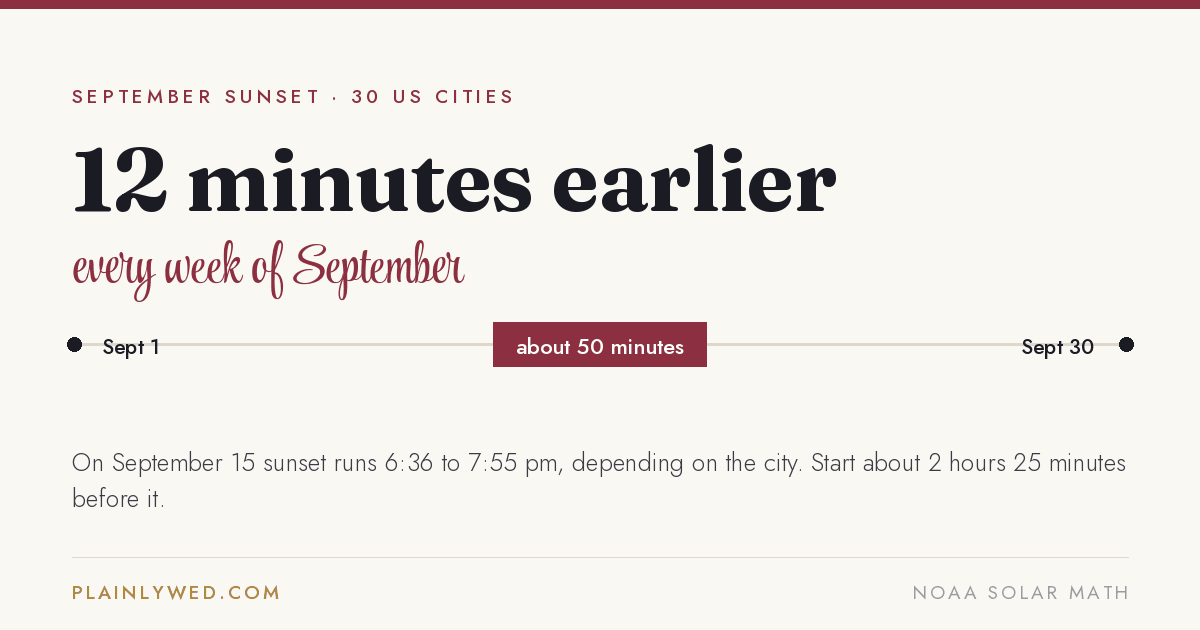
September has the fastest-moving sunset of the year
In most months, the gap between the 5th and the 26th is small. Small enough to ignore. September is not most months.
Run the numbers across the month and sunset moves about 12 minutes earlier every week. That’s the steepest rate of change in the calendar.
June, by comparison, moves about 3 minutes a week. And in the wrong direction.
Three weeks of September is therefore roughly 36 minutes of ceremony start time. Say you booked your venue picturing a September wedding. Then you moved the date three weeks later in the same month.
Your ceremony now has to start more than half an hour earlier than you pictured. Nobody tells couples this. Almost nobody does the math.
So that sample timeline you found on a wedding blog? The one written for “a September wedding”? It’s wrong for most of September.
There’s no such thing as a September ceremony time. There’s only a time for your date.
Sunset and ceremony start, 30 US cities
Times are for the 15th of September, 2027. They’re worked out from each city’s coordinates, with daylight saving applied. Sorted earliest sunset first.
Take one minute off the ceremony column for every two days later in the month. Add one minute for every two days earlier.
| City | Sunset | Ceremony, no first look | With a first look |
|---|---|---|---|
| Phoenix, AZ | 6:36 pm | 4:11 pm | 5:11 pm |
| Las Vegas, NV | 6:49 pm | 4:24 pm | 5:24 pm |
| Boston, MA | 6:55 pm | 4:30 pm | 5:30 pm |
| San Diego, CA | 6:56 pm | 4:31 pm | 5:31 pm |
| Nashville, TN | 6:56 pm | 4:31 pm | 5:31 pm |
| Los Angeles, CA | 7:01 pm | 4:36 pm | 5:36 pm |
| Chicago, IL | 7:01 pm | 4:36 pm | 5:36 pm |
| New York, NY | 7:06 pm | 4:41 pm | 5:41 pm |
| New Orleans, LA | 7:07 pm | 4:42 pm | 5:42 pm |
| Denver, CO | 7:10 pm | 4:45 pm | 5:45 pm |
| Philadelphia, PA | 7:11 pm | 4:46 pm | 5:46 pm |
| San Francisco, CA | 7:19 pm | 4:54 pm | 5:54 pm |
| Seattle, WA | 7:23 pm | 4:58 pm | 5:58 pm |
| Portland, OR | 7:24 pm | 4:59 pm | 5:59 pm |
| Miami, FL | 7:26 pm | 5:01 pm | 6:01 pm |
| Minneapolis, MN | 7:26 pm | 5:01 pm | 6:01 pm |
| Charleston, SC | 7:27 pm | 5:02 pm | 6:02 pm |
| Houston, TX | 7:28 pm | 5:03 pm | 6:03 pm |
| Kansas City, MO | 7:28 pm | 5:03 pm | 6:03 pm |
| Charlotte, NC | 7:31 pm | 5:06 pm | 6:06 pm |
| Jacksonville, FL | 7:33 pm | 5:08 pm | 6:08 pm |
| Dallas, TX | 7:34 pm | 5:09 pm | 6:09 pm |
| Austin, TX | 7:37 pm | 5:12 pm | 6:12 pm |
| Salt Lake City, UT | 7:38 pm | 5:13 pm | 6:13 pm |
| Asheville, NC | 7:38 pm | 5:13 pm | 6:13 pm |
| San Antonio, TX | 7:40 pm | 5:15 pm | 6:15 pm |
| Columbus, OH | 7:42 pm | 5:17 pm | 6:17 pm |
| Detroit, MI | 7:43 pm | 5:18 pm | 6:18 pm |
| Atlanta, GA | 7:45 pm | 5:20 pm | 6:20 pm |
| Indianapolis, IN | 7:55 pm | 5:30 pm | 6:30 pm |
Two things stand out in that table. Phoenix has the earliest September sunset on the list. Arizona doesn’t observe daylight saving, and everyone else does.
Indianapolis has the latest. It sits at the far western edge of the Eastern time zone. Neither has anything to do with latitude. Both catch people out.
Golden hour is at its shortest in September
And it gets worse. September has the fastest-moving sunset. It also has the shortest golden hour of the year. March, at the other equinox, ties it.
Measure it properly: from the sun six degrees above the horizon down to the moment it touches. Across these 30 cities the September window runs 31 to 40 minutes.
March, its mirror image, runs 31 to 41. June is 34 to 48 minutes. December is 34 to 52.
The two equinox months are the yearly low. September is just barely the shorter of them.
The reason is geometry. Near the equinox the sun crosses the horizon at its steepest angle of the year. So it drops through that six-degree band faster.
That same steep angle makes sunset move so fast from week to week. One cause, two effects. Both working against you.
You do get another 23 to 31 minutes of soft, usable light after the sun goes. That’s your buffer. In September you’ll probably need it.
In practice: September gives you the least margin for error of any month.
If family photos run fifteen minutes long in June, you absorb it. In September, fifteen minutes is half your golden window.
What is actually in season in September
September is the best month of the year for American-grown flowers. That matters. It’s the one time the answer to “can my florist get this” is usually yes.
The wholesaler Florabundance says it sources around 70 percent of its flowers from US farms. The window runs mid-March through October. That puts September right inside it.
Rose Story Farm in Carpinteria, California, ships field-grown garden roses from mid-April to mid-November. So September garden roses can be domestic, not flown in.
At peak and widely available: dahlias. The trade publication Florists’ Review puts them at mid-July through early to mid-fall. It reports growers in essentially every state.
Also sunflowers, chrysanthemums in bronze and red, zinnias, celosia, amaranth. Plus the ornamental grasses and millet that give September arrangements their texture.
Scabiosa, veronica, allium and Queen Anne’s lace are in the seasonal charts too.
Reliable year-round, because they’re imported: roses, carnations, alstroemeria, hydrangea, lisianthus, calla lilies, delphinium, freesia, eucalyptus, baby’s breath.
Not in season, and asked for constantly: peonies. Peonies run roughly late April to early June, with May at peak. Wholesale seasonal charts put them at March through July.
September peonies mean Southern Hemisphere imports. Growers and florists put the off-season premium at roughly double to triple the in-season price. That’s from their own experience, not published price data.
Sweet peas, lilac, lily of the valley and tulips are also out.
Want the peony look in September? The trade’s standard swap is garden roses.
You get an outer cup of petals around a dense center. A similar range of blush, cream and coral. They open more predictably than a peony, and cost less than an imported one.
Dinner-plate dahlias work too. In September they’re at their best.
Sources: Florabundance sourcing share via Thursd; Rose Story Farm shipping window and wholesale pricing; Florists’ Review on dahlia season; Blooms by the Box seasonal availability charts. The peony premium figure comes from named growers and florists describing their own purchasing, not from published price data, and we have not been able to verify the larger multiples that circulate on wedding sites.
The September checklist
- Use your date, not the month. Take the table figure for the 15th. Then adjust by roughly one minute for every two days.
- Protect the last 40 minutes. Family and wedding party photos are what overrun. In September the overrun eats the only window you can’t get back.
- Write the family photo list in advance. At about two minutes per grouping, a list of 25 is nearly an hour. Twelve is 25 minutes. Give the list to someone who knows everyone by sight.
- Consider the first look harder than you would in June. It buys back a full hour. In September that hour is the difference between portraits and no portraits.
- Ask your florist what’s coming out. Dahlias are magnificent in September. They’re gone after the first hard frost. In the northern half of the country, that can arrive in October.
- If dahlias are central to your palette, September is the safe month. October is a gamble.
Common questions
What time should a September wedding start?
Take your city’s sunset from the table above. Subtract 2 hours 25 minutes for a ceremony with all the photos afterward. With a first look, subtract 1 hour 25 minutes.
In New York on September 15 that’s a 4:41 pm ceremony. Adjust by about a minute for every two days away from the 15th.
How much does sunset change during September?
About 12 minutes earlier per week. That’s the fastest rate of any month in the year. Across the whole month you lose roughly 50 minutes of evening light.
A wedding on September 26 starts about 36 minutes earlier than the same wedding on September 5.
Is golden hour shorter in September?
Yes. Across 30 US cities, September’s window runs 31 to 40 minutes. That’s measured from six degrees of elevation down to sunset. It’s the shortest of the year, alongside March.
Near the equinox the sun crosses the horizon at its steepest angle. So it drops through that band faster. You get another 23 to 31 minutes of soft light after sunset.
Are dahlias in season for a September wedding?
Yes, September is their peak. The trade puts dahlia season at mid-July through early to mid-fall. Growers across the country supply it.
The limit is the first hard frost. So September is dependable nationally. October depends on where you are.
Can I have peonies at a September wedding?
Only imported ones. Peonies run roughly late April to early June, with May at peak. Wholesale charts put the season at March through July.
September stems come from the Southern Hemisphere. Growers and florists put the premium at roughly double to triple in-season pricing.
The usual swap is garden roses. They give a similar shape and color range, and cost less than imported peonies.
The wedding timeline maker works out sunset for your exact date and venue. Not the 15th of the month. Then it builds the whole day backward from there.
The color palette generator checks your palette against what’s really in season in your wedding month. Both free. No signup.
How these numbers were calculated
We work out sunset times from each city’s latitude and longitude. The math uses the NOAA solar position algorithm. It applies the standard 90.833 degree zenith, which accounts for atmospheric refraction and the sun’s apparent size.
Local clock times use each city’s IANA time zone, so daylight saving comes out right. That includes Arizona, which doesn’t observe it.
Golden hour uses a solar elevation of six degrees. The end of usable light uses civil twilight, six degrees below the horizon. Spot checks against published almanac times agree to within one minute.
These are times for a flat horizon. Does your venue have high ground or tall buildings to the west? Direct sun will leave 15 to 30 minutes earlier.
Stand at the ceremony spot at the same time of day and watch.
Last updated August 29, 2026.